

Use synthesis to bring evidence together around a research decision. A synthesis explains what each source can support and where you need more evidence.
Prepare checked sources
Open the summaries you want to combine. Check that each one identifies the study question, source files, and limits. Compare periods and sample definitions before combining measures.
In this fictional retail study, one file summarizes shopper and store-team interviews. Another checks responses to a checkout survey.
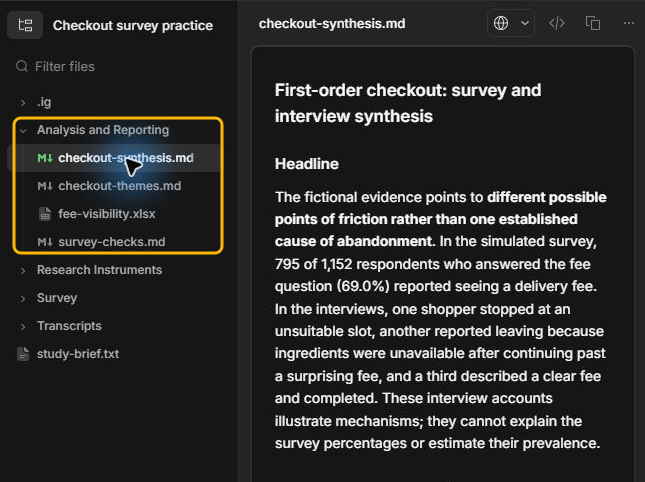
For the example, create checkout-themes.md in Complete a qualitative study and check a finding in Part 3. Create and check survey-checks.md in Complete a quantitative study. Confirm both files are in Analysis and Reporting in the same project.
If you extracted the 1,200-response survey into a new practice folder, open that project. Copy your checked interview note into its Analysis and Reporting folder or create the note again there.
Ask for an evidence-based synthesis
-
In Research, reference each source summary. Name the decision and tell the agent which evidence types to keep distinct.
-
Ask for the exact source of each finding, any disagreement or gap, and a next step the evidence supports. For the retail study, send this request.
Use both notes in Analysis and Reporting: checkout-themes.md and survey-checks.md. Label the evidence type and cite the exact source for each finding. Explain disagreements and gaps, then give a next step the evidence supports. Keep interview observations separate from survey percentages. Save Analysis and Reporting/checkout-synthesis.md and link it in the reply. -
Open
checkout-synthesis.mdfrom the reply. Compare one finding from each evidence type with its original source.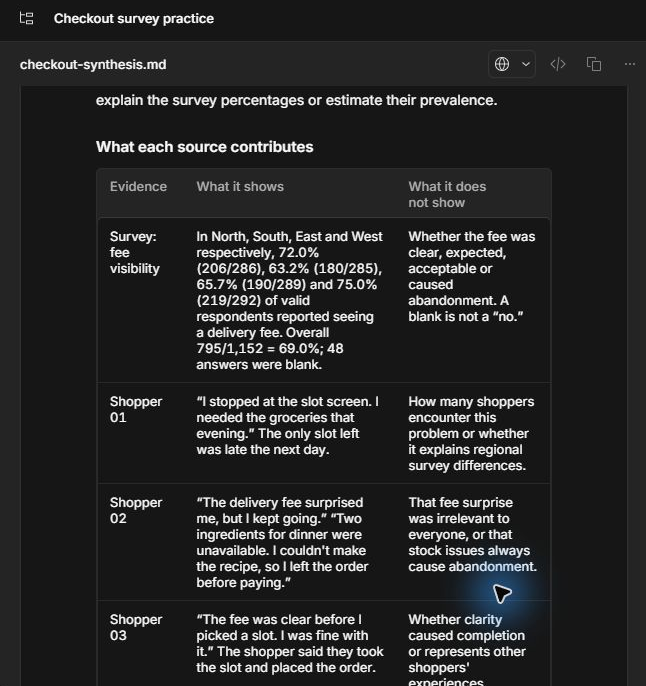
Your synthesis may emphasize different findings. To practise checking one, compare the delivery-slot account in Transcripts/Shoppers/shopper-01.md with the completed order in Transcripts/Shoppers/shopper-03.md. Check Survey/survey-guide.md to see which parts of checkout the survey asked about.
Decide what the evidence supports
- Use interview quotes to explain an experience and include examples that differ.
- Use survey percentages with their valid bases and any missing answers.
- Keep potential explanations visible when the study does not establish a cause.
Use Evaluate research outputs to check the synthesis before reporting. Use Create a PowerPoint presentation when you need to present the findings.